surmenage · · evergreen · poster · strategy · innovation · teamwork
kitepower, an a3 poster on a kite that rents itself out
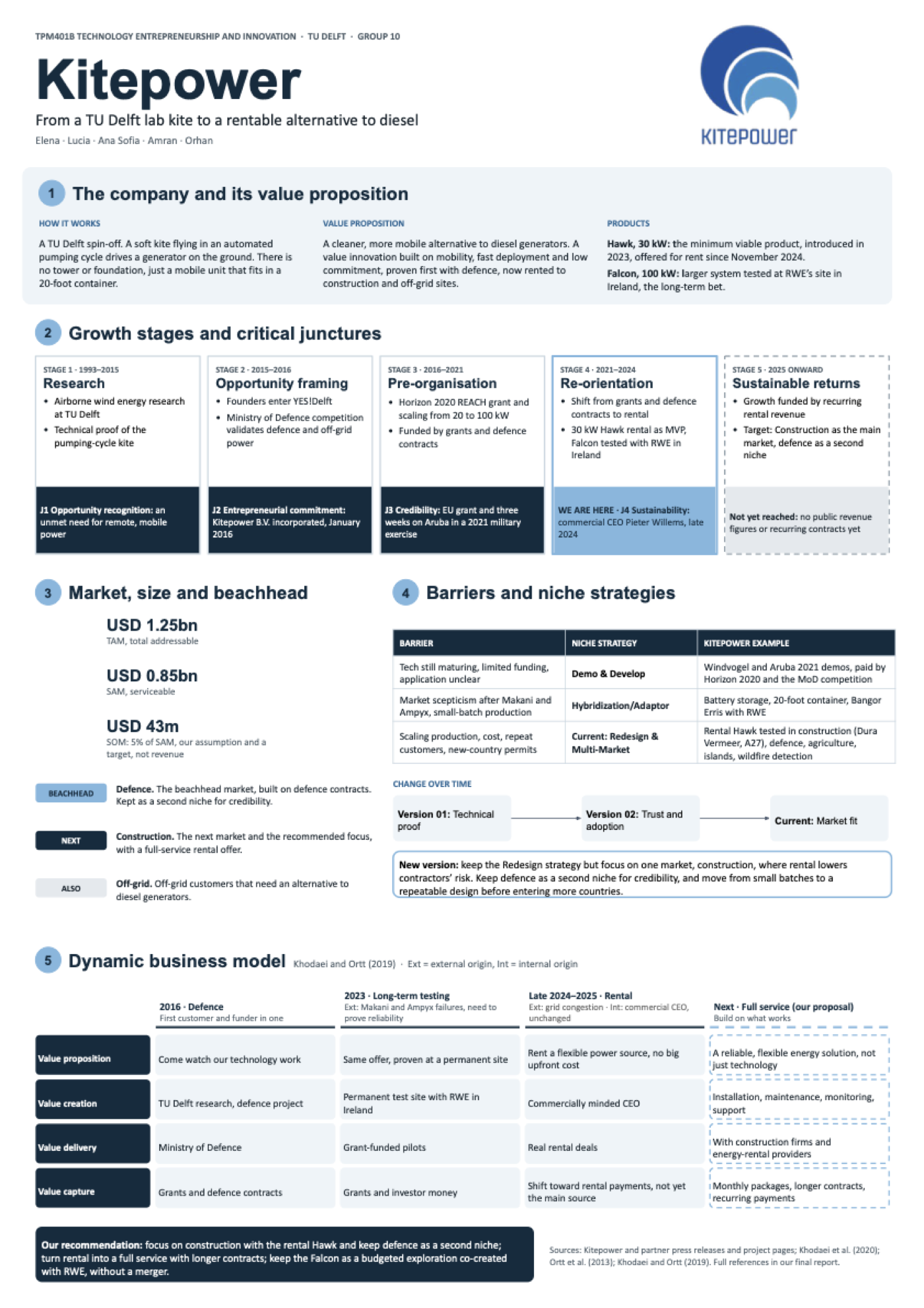
The poster as exported, page 1 of the A3 PDF.
What it is
This is a single A3 poster about Kitepower, a TU Delft spin-off that flies a soft kite in an automated pumping cycle to drive a generator on the ground. It is a group piece made by a group of five. The subtitle reads “From a TU Delft lab kite to a rentable alternative to diesel”. The footer says full references are in our final report, so the poster is the summary of a longer written analysis, and it ends with a recommendation rather than just a description.
What it shows
The content is numbered in five blocks.
- The company and its value proposition: a mobile alternative to diesel generators that fits in a 20-foot container, with the 30 kW Hawk (offered for rent since November 2024) and the 100 kW Falcon, tested at RWE’s site in Ireland.
- Growth stages and critical junctures: five stages from 1993 research to rental-funded growth from 2025, with junctures J1 to J4 marked and a “we are here” flag at J4 (sustainability). The poster is explicit that the last juncture is not yet reached, since there are no public revenue figures or recurring contracts.
- Market size and beachhead: TAM of USD 1.25bn, SAM of USD 0.85bn and SOM of USD 43m. The SOM is 5% of SAM and is labelled as our assumption and a target, not revenue. Defence is the beachhead, construction the next market, off-grid an additional one.
- Barriers and niche strategies: a table pairing each barrier with a niche strategy and a Kitepower example, such as Demo & Develop, Hybridization/Adaptor, and Redesign & Multi-Market.
- Dynamic business model: four columns from 2016 defence to a proposed full-service rental, each broken down into value proposition, creation, delivery and capture.
The recommendation: focus on construction with the rental Hawk, keep defence as a second niche, turn rental into a full service with longer contracts, and keep the Falcon as a budgeted exploration co-created with RWE, without a merger.
How it is laid out
Numbered section headings run roughly left to right and top to bottom. The stages are a five-column timeline with the junctures underneath. The barriers are a three-column table. The market is three big figures with the three segments beside them. The business model is a grid with rows for the four value dimensions. The sources are credited to Kitepower and partner press releases, project pages, and the academic literature on niche strategies (Khodaei and Ortt, among others).
What I would say about it
It is dense, as a poster from a course usually is. What I care about is that the unknowns are stated on the page: the SOM is an assumption, J4 is not reached, and the recommendation is ours. I have not recorded here which course it was for or how the layout was produced, because the files do not say.
- poster
- strategy
- innovation
- teamwork