surmenage · · budding · ml · music · survey · hci
ai that performs alongside humans: a survey of live co-performance
This is a write-up of a survey I wrote with a classmate for a TU Delft research seminar (IN4313, multimedia), between mid-May and late June 2026. It is a course project and a literature argument: I built no system and ran no study. The question was what the research on AI that performs live with a human musician actually shows, and what it keeps failing to ask.
what counts as a co-performer
I wanted a definition narrow enough to exclude most of what gets called “AI music”. A co-performer is a system that generates music in real time during a performance, with a delay short enough for interactive response, and that plays with a person, not for them or instead of them. I took the “live” criterion from the Lyria paper from Google DeepMind: real-time factor of at least 1, causal streaming, interactive delay. Offline generation tools, DAW plugins and works where the music is secondary to visuals or dance were out.
In late May I classified the 31 papers I then had PDFs for as YES (squarely about a live co-performer), PARTIAL (theory, critique, evaluation method, adjacent infrastructure) or NO (foundations everyone cites). The final survey grew to 36 papers, with a 1984 floor so that Dannenberg’s score follower counts as the origin.
| class | count | examples |
|---|---|---|
| YES | 19 | OMax, Somax 2, Shimon, In a Silent Way, ReaLJam, Aria-Duet, Lyria / Magenta RT, MACAT, Adaptive Elusion, Touching Wires |
| PARTIAL | 10 | Factor Oracle theory, Morreale’s critique, Donnarumma on corporeal knowledge, Diff-A-Riff |
| NO | 2 | the Transformer paper, RAVE |
The corpus skews toward system demonstrations and practitioner reflections; only a minority report controlled user studies.
two ways to sort the systems
By mechanism there are three groups. Reactive improvisation systems recombine the performer’s live material: the Continuator (a Markov model), OMax and Somax 2 from IRCAM (Factor Oracle models learned during the performance, no pre-training), and Shimon, the robotic marimba player. Deep-learning streaming systems run a large pretrained model inside a latency budget: Lyria / Magenta RT (750M parameters, open weights, 48 kHz), Aria-Duet on a Yamaha Disklavier, and ReaLJam, a browser jam tool on an RL-tuned transformer. Artist-trained systems are built from one performer’s small corpus: MACAT and MACataRT, and Esteso, a double-bass duet system.
By design premise, a system is generic if it is built for any performer from a corpus assembled beforehand, and bespoke if it is built for or from one artist or event. The axes cross-cut. The Continuator is reactive and generic; Dahlstedt’s Adaptive Elusion is reactive and bespoke, since its small models start empty, learn only from the pianist that night, and are discarded. Lyria is deep-learning and generic; the jam_bot that played a sold-out 2024 concert with Jordan Rudess is deep-learning and bespoke, a 360M-parameter pretrained Anticipatory Music Transformer fine-tuned on his MIDI recordings.
An earlier draft argued only about the generic/bespoke split and its consequences for authorship and training-data ethics. We changed the thesis because the user studies kept pointing somewhere else.
claim one: latency is largely solved
For forty years the question was whether a machine could answer a live musician fast enough to feel like a partner. Reactive systems got sub-beat response by construction, since they learn from live input and never run ahead of it. Streaming systems then brought large models inside the budget: Aria-Duet gets around 100–200 ms by bypassing the Disklavier’s native 500 ms MIDI buffer and repairing note durations speculatively, and Lyria meets real-time factor 1. What remains is a trade-off Karchkhadze and Dubnov state in their Max/MSP latent-diffusion paper: latency, quality and look-ahead depth cannot all be optimised at once.
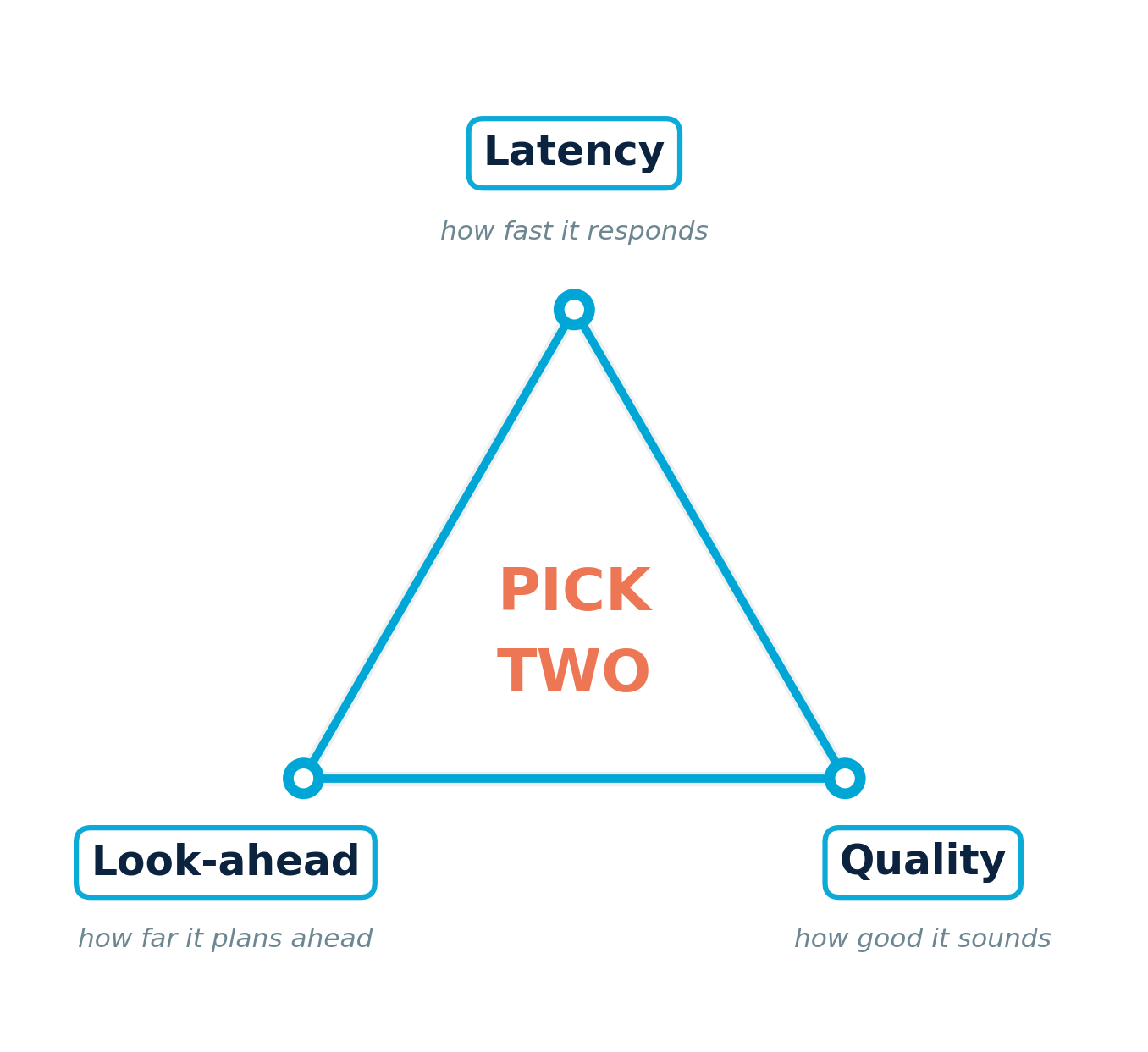
The latency / quality / look-ahead trilemma, drawn for our talk.
The ReaLJam study is the hinge. Six expert musicians used it with a waterfall display of the chords the AI was about to play. Mean enjoyment was 4.3 out of 5. Users generally agreed that not seeing the chords made a session more musically interesting, because of the surprise. Yet five of six chose to see them in their last performance. They paid a musical cost to see inside the AI. Temporal co-presence was fine; something else was missing.
I should record a mistake. A June 1 draft of ours said five of six participants disabled the display, which is the reverse of what the paper reports. The final version has it right, and the third claim depends on that direction.
claim two: generic versus bespoke is a premise
The sharpest generic-side evidence is the LOERIC evaluation. Seven Irish traditional musicians played with a rule-based system for Irish dance music, and enjoyability reached 7.0 out of 10 in its best condition. They still identified the machine at once, not by latency but because it could not swing, could not follow their ornamentation and microtiming, and made the human follow it. Morreale and colleagues argue the theory: a system built to play with anyone is trained on a corpus no single tradition defined, and treats deviation as error.
Bespoke systems answer to one vocabulary on purpose. MACAT’s authors decline quantitative evaluation because standard metrics do not measure fidelity to one artist’s voice. Esteso cannot play with anyone but its bassist. The jam_bot shows the premises can be combined: a listening study (N=24) rated it indistinguishable from Rudess. But its authors say the pretrained model’s Western tonal bias survives fine-tuning, so someone still has to choose which tradition it answers to.
I read these as two answers to what co-performance is for. Generic systems are a partner available to anyone. Bespoke systems are a single artistic statement where the AI extends one artist and the artwork is the relationship. Running them together is part of why evaluation fits so badly.
claim three: legibility is the open problem
By legibility I mean the performer can understand what the AI is contributing, predict where it will go, and act on that in real time. Three results line up.
- Ma and Martin’s Touching Wires study (N=12): when the AI became unpredictable, performers withdrew. “I just had to do my own thing.”
- In a Silent Way (seven instrumentalists, an AI drummer): truthful confidence signals raised performer flow (4.00 against 3.57 for deceptive ones, p < 0.01). Sending skin conductance from performer to AI had no measurable effect, so the benefit ran one way.
- Shimon: with the algorithm identical, audiences who could see the robot rated the performance higher on 10 of 11 scales than those who only heard it. The arm moves toward the next note well before the strike, so the human sees it coming.
Bryan-Kinns and colleagues’ meta-review of 100 AI music systems gives a vocabulary. Stage 1: the performer knows something is generated. Stage 2: they can see what the model did. Stage 3: they understand why, in a way they can act on. Eighty-four of the 100 systems sit at Stage 1. ReaLJam’s waterfall and Shimon’s gestures reach Stage 2, and as far as I can tell from the papers nothing in the corpus reaches Stage 3. Xambó and Roma’s live-coding framework (legibility, modifiability, predictability, cardinality) gives the same picture: no system scores high on all four.
The field drifted because of measurement. Latency can be read off a recording and real-time factor is a training objective. Legibility has no metric and no loss function, so it drops out of what gets optimised. Row and Fazekas ask whether the AI’s contribution is interpretable and actionable, not whether its music is good, but current instruments conflate the two.
is this just explainable AI?
Partly. Standard explanation arrives after the prediction, which is useless once the musical moment has passed; live co-performance needs predictive legibility. The goal is steering, not justification. And part of the problem is not explanation: no interface bolted onto LOERIC would make it swing. Opacity and cultural bias look to me like one problem at two levels, interface and training data. The design prescription is not a new architecture. Bespoke systems show legibility is achievable when the vocabulary is the performer’s own, and generic systems supply the streaming infrastructure and partial mechanisms like the waterfall and confidence emoticons. The unoccupied space is generic systems with legibility built in.
what is unfinished
The Stage 3 claim is a claim about absence, from reading papers; I tested no system, and a paper that does not describe a mechanism is not proof it lacks one. Evidence is mostly performer-side and small, N between 6 and 24. Audience evidence is sparse, and nothing in the corpus puts a live audience in a realistic co-performance setting. The corpus is Western, tonal, piano and percussion heavy, so arguing against Western dominance from it is somewhat self-undermining. Next would be concert studies separating performer from audience experience, and a prototype of a generic system that exposes its intent, perhaps extending ReaLJam’s waterfall toward Stage 3, to test whether performers still keep the display on.
- ml
- music
- survey
- hci